

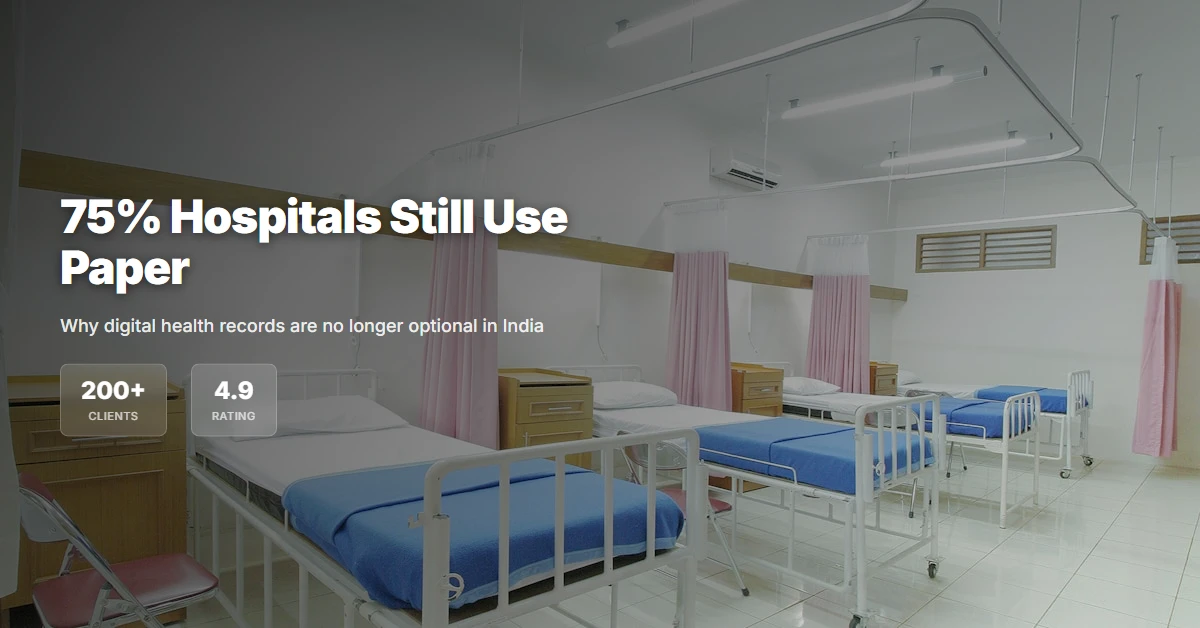
India is one of the fastest-growing healthcare markets in the world. But here is a shocking fact: only 25% of urban healthcare facilities in India have adopted electronic health records (Market.us, 2026). Compare this to 95% in the United States.
Why are Indian hospitals still using paper records? And what are they missing out on?
The Real Cost of Paper Records
- Medication errors: EHR reduces medication errors by 48% (Market.us)
- Duplicate tests: Paper records lead to 30% more redundant diagnostic tests
- Patient wait time: Digital registration reduces wait time by 40%
- Revenue leakage: Paper billing misses 8-12% of billable services
- Data loss: Paper records can be lost, damaged, or stolen
Why Indian Hospitals Resist Digital
1. “Our Doctors Will Not Use It”
This is the #1 objection. But it is a training problem, not a technology problem. Hospitals that provide proper training see 90%+ adoption within 3 months.
2. “It Is Too Expensive”
Basic EHR costs ₹3-5 lakh per year for a 50-bed hospital. Compare that to the revenue leakage from paper billing (₹5-15 lakh annually). The software pays for itself in 4-6 months.
3. “Internet Is Unreliable”
Modern HMS solutions work offline and sync when connectivity returns. This is a solved problem.
4. “We Do Not Have IT Staff”
Cloud-based HMS requires zero IT infrastructure. Your existing staff can manage it with 2-3 hours of training.
What Digital Health Records Actually Do
| Feature | Benefit | Impact |
|---|---|---|
| Patient Registration | 3-minute check-in vs 12 minutes | 75% faster |
| E-Prescriptions | No handwriting errors | 48% fewer medication errors |
| Lab Integration | Results directly to doctor’s screen | 80% faster diagnosis |
| Billing Automation | No missed charges | 15-20% revenue increase |
| Insurance Claims | Automated claim submission | 60% faster settlements |
| Patient Portal | Online appointments, reports | 35% fewer no-shows |
India’s Digital Health Initiative
The Indian government is pushing digital health through:
- ABHA (Ayushman Bharat Health Account): Digital health ID for every citizen
- NDHM (National Digital Health Mission): Interoperable health records
- DigiLocker: Digital storage for health documents
Hospitals that adopt digital systems now will be ready for these government initiatives. Those that wait will struggle to comply.
How to Transition from Paper to Digital
- Start with registration – Digital check-in is the easiest win
- Add billing – Automate invoicing and insurance claims
- Implement EHR – Digital patient records across departments
- Integrate pharmacy and lab – Complete digital ecosystem
- Add patient portal – Online appointments and reports
FAQ
Q: How long does digital transition take?
A: Basic transition (registration + billing): 2-4 weeks. Full EHR implementation: 2-3 months.
Q: What about existing paper records?
A: HMS vendors provide data migration services. Existing records can be digitized gradually.
Q: Is digital health records secure?
A: Yes. Modern HMS uses encryption, access controls, and regular backups. More secure than paper records.
Q: Can small clinics afford digital records?
A: Yes. Basic HMS starts at ₹2,000-3,000/month. Cloud-based solutions require no hardware investment.
Q: Will doctors resist the change?
A: Some initially, but most adapt within 2-4 weeks. The key is choosing user-friendly software and providing proper training.
Digital health records are not just a technology upgrade – they are a patient safety imperative. Every day without digital records is a day of preventable errors, lost revenue, and compromised care.
Explore Lexx.in Hospital Management System with Digital Health Records – or call +91 9045436254 for a free demo.
Sameer Hasan is a Business Technology and Healthcare IT Specialist with 9+ years of experience. She has helped 150+ businesses across India transition to digital health records. Connect with Dr. Mehta at lexx.in/author/sameer-hasan


