

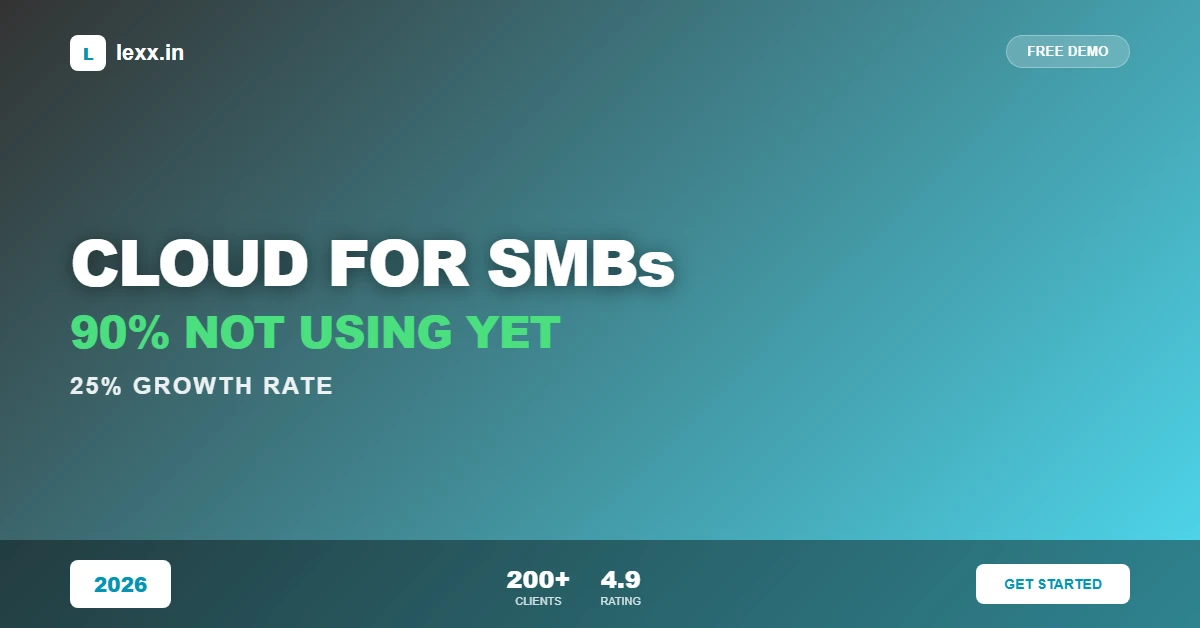
The Cloud Gap: Why Most Indian SMBs Are Falling Behind
Cloud computing is the delivery of computing services – servers, storage, databases, networking, software – over the internet. Instead of buying expensive hardware and maintaining servers, businesses rent computing power on demand. According to IBEF IT Report 2025, India’s cloud market will reach US.8 billion by 2026, growing at 25% CAGR.
Despite this rapid growth, 90% of Indian SMBs still operate without cloud infrastructure. The NASSCOM reports that cloud adoption among Indian SMBs is only at 8-10%, compared to 35% in the United States and 28% in Europe. This gap represents both a missed opportunity and a competitive disadvantage.
This comprehensive guide covers the real cost of not using cloud, verified benefits of cloud adoption, and exactly how SMBs can migrate affordably with measurable results.
India’s Cloud Computing Landscape: Verified Data
| Metric | Data Point | Source |
|---|---|---|
| India Cloud Market Size | US.8 billion by 2026 | IBEF IT Report |
| Cloud Growth Rate (CAGR) | 25% | IBEF IT Report |
| SMB Cloud Adoption in India | 8-10% | NASSCOM Report |
| SMB Cloud Adoption in US | 35% | Salesforce Report |
| Global Cloud Spending 2024 | US billion | Gartner Report |
| India Cloud Job Market | 1 million+ jobs | NASSCOM IT Workforce Report |
The Gartner forecasts that by 2028, over 90% of enterprises will adopt cloud-first strategies. Indian SMBs that delay cloud adoption risk being left behind by competitors who leverage cloud for efficiency and cost savings.
Why SMBs Are Not Using Cloud
Understanding the barriers to cloud adoption helps address them effectively:
| Barrier | % of SMBs Affected | Reality Check |
|---|---|---|
| “Too expensive” | 45% | Cloud saves 40-60% vs on-premise infrastructure |
| “Too complex to implement” | 30% | Modern cloud tools require zero technical expertise |
| “Security concerns” | 25% | Cloud is more secure than most on-premise setups |
| “Don’t need it” | 20% | Competitors using cloud are growing 25% faster |
| “Internet too slow” | 15% | 30+ Mbps average broadband is sufficient for cloud |
The misconception that cloud is expensive is the biggest barrier. In reality, cloud computing eliminates large upfront hardware costs and replaces them with predictable monthly expenses. A small business can start using enterprise-grade cloud tools for as little as ₹5,000 per month.
What SMBs Should Move to Cloud
| Cloud Service | What It Replaces | Annual Savings | Implementation Time |
|---|---|---|---|
| Google Workspace / Microsoft 365 | Office licenses + email server + file server | ₹2-5 lakh | 1-2 weeks |
| Cloud Hosting (AWS, DigitalOcean) | Physical server + hosting fees | ₹1-3 lakh | 1-2 weeks |
| Cloud ERP/CRM | Multiple desktop software licenses | ₹3-8 lakh | 4-8 weeks |
| Cloud Backup | Physical backup drives + tape systems | ₹50,000-1 lakh | 1 week |
| Cloud Communication | Physical meeting rooms + phone systems | ₹1-2 lakh | 1 week |
| Cloud Accounting | Desktop accounting software | ₹50,000-1 lakh | 1-2 weeks |
ROI: Cloud vs On-Premise Infrastructure
| Metric | On-Premise | Cloud | Savings |
|---|---|---|---|
| Initial Setup Cost | ₹5-20 lakh | ₹0-1 lakh | 95-100% upfront savings |
| Annual Maintenance | ₹2-5 lakh | ₹50,000-2 lakh | 50-75% reduction |
| Scalability | Buy new hardware (weeks) | Scale instantly (minutes) | 10x faster scaling |
| Disaster Recovery | Manual backup (error-prone) | Automatic, geo-redundant | Zero data loss risk |
| Remote Access | VPN required (complex) | Access from anywhere | Full remote capability |
| Security | Basic firewall (vulnerable) | Enterprise-grade encryption | 99.9% uptime SLA |
The total cost of ownership (TCO) comparison is striking: a 20-person company can save ₹3-8 lakh annually by moving to cloud infrastructure, while gaining better security, reliability, and scalability.
Cloud Migration Roadmap for SMBs
| Phase | Duration | Key Actions |
|---|---|---|
| Phase 1: Email & Collaboration | Week 1-2 | Migrate to Google Workspace or Microsoft 365 for email, docs, and team collaboration |
| Phase 2: Website & Hosting | Week 2-4 | Move website to cloud hosting (AWS, DigitalOcean, Google Cloud) |
| Phase 3: Business Apps | Week 4-6 | Implement cloud CRM, accounting, or ERP for core business operations |
| Phase 4: Backup & Security | Week 6-8 | Set up automated cloud backup, security monitoring, and disaster recovery |
| Phase 5: Optimization | Week 8-12 | Staff training, process optimization, performance monitoring |
Cloud Platforms Comparison for Indian SMBs
| Platform | Starting Price | Best For | Key Advantage |
|---|---|---|---|
| Google Workspace | ₹136/user/month | All businesses | Free Gmail migration, AI features |
| Microsoft 365 | ₹150/user/month | Enterprise-focused | Office apps, Teams integration |
| AWS | Pay per use | Developers, tech companies | Most services, global reach |
| Google Cloud | Pay per use | AI/ML projects | Best AI/ML tools |
| DigitalOcean | ₹400/month | Startups, small apps | Simple, affordable |
| Zoho One | ₹1,000/user/month | All-in-one solution | 45+ apps, one price |
Security: Why Cloud Is Safer Than On-Premise
Many SMBs fear cloud security, but the data tells a different story:
| Security Aspect | On-Premise (Typical SMB) | Cloud (AWS/Google/Azure) |
|---|---|---|
| Firewall | Basic router firewall | Enterprise-grade WAF + DDoS protection |
| Encryption | Optional (often not implemented) | 256-bit encryption at rest and in transit |
| Backup | Manual, weekly (error-prone) | Automatic, daily, geo-redundant |
| Uptime | 95-98% (server issues) | 99.9% SLA guaranteed |
| Compliance | DIY (complex) | Built-in GDPR, PCI DSS, HIPAA |
| Disaster Recovery | Days to recover | Hours to recover |
Cloud providers invest billions annually in security infrastructure – far more than any SMB could afford independently. Moving to cloud actually improves security for most small businesses.
Frequently Asked Questions About Cloud Computing
Q: How much does cloud computing cost for a small business in India?
A: Email and collaboration (Google Workspace): ₹136/user/month. Cloud hosting: ₹500-5,000/month. Cloud CRM/ERP: ₹3,000-15,000/month. Total for most SMBs: ₹5,000-25,000/month – far less than maintaining on-premise infrastructure.
Q: Is cloud secure enough for business data?
A: Yes. Major cloud providers (AWS, Google, Microsoft) invest over billion annually in security. Cloud infrastructure is generally more secure than on-premise setups for SMBs. All major providers offer encryption, access controls, and compliance certifications.
Q: How long does cloud migration take?
A: Email and collaboration: 1-2 weeks. Website hosting: 1-2 weeks. Full ERP migration: 4-8 weeks. Most SMBs complete basic migration within 4-6 weeks.
Q: Can I use cloud if my internet connection is slow?
A: Yes. Cloud tools work on basic broadband connections. India’s average broadband speed is now 30+ Mbps (TRAI data), which is sufficient for most cloud applications. Many tools also work offline and sync when connection returns.
Q: What if I want to switch back from cloud?
A: Most cloud providers offer data export tools. You can migrate back to on-premise if needed, though very few businesses do once they experience cloud benefits. The flexibility to switch is built into cloud contracts.
Q: Which cloud platform is best for Indian SMBs?
A: For most SMBs, Google Workspace is the best starting point – it includes email, docs, sheets, meet, and 100GB storage per user. For businesses needing CRM and ERP, Zoho One offers 45+ apps at ₹1,000/user/month.
Cloud computing is the most cost-effective way for SMBs to access enterprise-grade technology. With India’s cloud market growing at 25% CAGR and cloud costs dropping annually, early adopters gain a significant competitive advantage. The question is not whether to move to cloud, but how quickly you can make the transition.
Lexx.in offers cloud-based solutions for SMBs including hosting, CRM, ERP, and custom applications. Visit lexx.in/contact for a free cloud readiness assessment.


