

Forget everything you learned about ranking #1 for a long-tail keyword. That’s a different game now. Google Discover doesn’t care about your keyword density or your carefully crafted meta description – it cares about whether it thinks you, specifically, will stop scrolling and tap. It’s less “search engine” and more “algorithmic mind reader.”
Honestly, understanding that shift has been the single biggest traffic unlock for us here at lexx.in. I’ve watched our own pages go from a few hundred daily visitors to tens of thousands overnight just because one article landed in the Discover feed. But I’ve also watched perfectly well-written pieces get completely ignored because we didn’t think about what makes Discover tick.
The difference usually comes down to a handful of things – and most of them have nothing to do with traditional SEO. Here is the exact blueprint we use at lexx.in to move the needle.
1. Your Image Isn’t Decoration – It’s the Pitch
Text-first thinking will kill your Discover performance. On Search, your headline and meta description do the selling. On Discover, the image does 80% of the work before anyone reads a single word. We learned this the hard way.
A few non-negotiables we strictly follow:
- Hit 1200px minimum width, and make sure
max-image-preview:largeis set in your header. Skip this and Google will either shrink your image into irrelevance or not show it at all. This one’s purely technical – there is no excuse to miss it. - Ditch the stock photography. Nothing kills a scroll faster than a recognizable stock shot of two people in blazers shaking hands in front of a laptop. When we stopped using generic filler on lexx.in and switched to custom graphics and real screenshots, our click-through rates jumped immediately. Readers have seen stock photos a thousand times; their brains are wired to skip them.
Think of the image as a mini pitch for your article. If it doesn’t tell someone what’s inside within half a second, it’s not doing its job.
2. Headlines Need to Create an Itch, Not Just Describe
Discover runs on curiosity and interest-matching. Your headline has exactly one job: make someone feel like they need to know more. But there’s a fine line here, and crossing it will cost you.
Compare these two titles from our early editorial tests:
- “A Guide to AI Automation Tools” – technically accurate, completely forgettable.
- “Why Traditional Workflows Are Dying to Autonomous AI Agents” – same topic, but now there’s tension, a stake, something to resolve.
That second version isn’t clickbait – it’s a headline that respects the reader enough to give them a reason to care. The trap most publishers fall into is confusing “curiosity” with “exaggeration.” Google’s systems are genuinely good at spotting headlines that overpromise. If our article doesn’t deliver on what the title implies, users bounce immediately. Discover reads that bounce loud and clear, and your visibility drops. Fast.
At lexx.in, our rule is simple: write headlines that pull people in, but never write a check your content can’t cash.
3. Be Fast, Be Specific, and Actually Name Names
Discover has a soft spot for freshness and for content built around recognizable entities – brands, public figures, tools, trending topics. This isn’t about keyword stuffing; it’s about giving Google’s language models enough context clues to understand exactly what your piece is about.
Two things matter here:
- Write with real entities woven in naturally. If you’re writing about workflow automation and AI agents, don’t dance around it with vague phrasing. Name the tools, name the companies, name the trend. It helps machines and humans alike.
- Speed matters more than you’d think. When something breaks in the tech or digital space, being one of the first to publish a genuinely thorough take gives you a real shot at capturing that first wave of Discover traffic. In the Discover feed, “good enough and fast” often beats “perfect and late.”
4. If Your Site Feels Slow, You’ve Already Lost
Every single Discover impression comes from someone’s phone. Not a desktop, not a tablet – a phone, usually while they’re half paying attention to something else. That changes the rules on user experience entirely.
If your WordPress site feels slow and takes more than two seconds to load, or the layout jumps around because an ad decided to render three seconds late, people are gone before they’ve even seen your headline properly. Google reads that bounce as a quality signal.
Practical fixes we obsessed over at lexx.in:
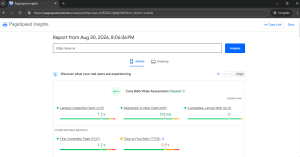
- Get your Core Web Vitals in order – check your site on Google’s PageSpeed Insights. This isn’t optional homework; it’s table stakes for 2026.
- Keep formatting mobile-friendly: use short paragraphs, real subheadings, and bullet points. Nobody wants to squint through a wall of text on a 6-inch screen while standing in line for coffee.
The Real Takeaway
Google Discover isn’t a slot machine, even though it can feel that way when a random article suddenly explodes. It rewards a very specific combination: images that pull their weight, headlines that create genuine curiosity without lying, content built around real, timely topics, and a site that doesn’t get in its own way technically.
Once we got those four things right consistently at lexx.in, Discover stopped being a lucky break and became a predictable channel. That’s the actual goal here – not one viral spike, but a traffic source you can rely on month after month.